Holiday Stress: How to Get Through December Without Running on Empty
December stacks small decisions until the evenings disappear. How to make fewer choices, protect two nights a week and set a good enough Christmas.

Holiday stress rarely arrives as one big problem. It builds out of small ones: a gift you still have not found, a dinner to plan, a group chat that will not stop, an evening that vanishes into wrapping paper. By mid-December, plenty of people feel a kind of tired that a good night's sleep does not fix.
This guide is about getting through the month with something left in the tank. Not a perfect Christmas, just a calmer one: fewer decisions, a couple of evenings you protect, expectations you set on purpose, and some time each day away from the scroll.
What actually causes holiday stress?
Holiday stress mostly comes from volume, not from any single task. December stacks extra decisions, extra spending, extra social time and extra travel on top of a normal working month, while taking away the quiet evenings that usually help you recover. The answer is less about relaxing harder and more about removing load.
It helps to name the load, because each part has a different answer:
- Dozens of small decisions a day, most of them about other people's preferences.
- Money leaving faster than usual, even when you planned for it.
- More time with people, including people you love but rarely see for this long.
- Fewer quiet evenings, because December fills them first.
- A picture of how Christmas should feel, which the real one rarely matches.
None of these is dramatic on its own. Together, over four weeks, they add up. The sections below take them one at a time, starting with the one that is easiest to change.
Make fewer decisions in December
Decide things once and reuse the answer all month. Pick a rule for gifts, a short list of easy dinners for busy nights, and a standard reply to invitations, then stop reopening them. Every choice you settle in advance is one you do not have to make at nine in the evening, when your patience is lowest.
Set one rule for gifts
Instead of choosing thirty presents one by one, choose a rule. Everyone gets a book. Everyone gets something to eat. The adults draw names and each buys one gift. A rule turns thirty open questions into one closed answer, and it usually helps the budget too. For the people who are hard to shop for, a short curated page such as our Christmas gifts for people who need to unwind narrows the field to a handful of options instead of the whole internet.
Repeat the easy dinners
Pick three weeknight meals you can cook without thinking and rotate them until Christmas. Nobody will mind in December, and the nightly question of what to eat drops from a daily task to nothing at all.
Have a default answer for invitations
Decide now how many evening events a week you will say yes to. For most people, two is plenty. When an invitation arrives, you are no longer weighing it from scratch; you are checking whether that week still has room. A ready sentence helps: "Thank you, we can't make that one, but we would love to see you in January."
Protect at least two evenings a week
Block two evenings a week in your calendar before December fills them, and treat them like any other appointment. Nothing planned, nobody visiting, no wrapping marathon. These are the nights that let you recover from the busy ones, and they are much easier to defend when they are already written down.
The point of a protected evening is that it asks nothing of you. Dinner can be leftovers. The dishes can wait until morning. You come home, and from that moment until bed there is no obligation on the calendar.
What you do with it matters less than what you avoid. Most people already know what helps them unwind: music and a cup of tea, a bath, a book, a long call with one friend instead of a group. If you want something that feels festive without being busy, our guide to Christmas activities for adults has quiet ideas for one person or two.
Guard the hour before bed as well, even on busy nights. A short, predictable wind-down tells your body the day is over, which matters more in a month of late dinners, travel and irregular sleep than at any other time of year.
Lower your expectations before December does it for you
Decide in advance what a good enough Christmas looks like, and say it out loud to the people you share it with. A lot of holiday stress lives in the gap between the season you picture and the one you have time, money and energy for. Shrinking that gap on purpose is easier than closing it in a rush.
Keep the parts people would actually miss
Ask everyone in the house to name the one or two parts of Christmas they would miss if they disappeared. The answers are usually short and surprisingly modest: a particular meal, one film, a walk, a specific dessert. Keep those and do them well. Let everything else become optional. You may find that some of the traditions you work hardest on are ones nobody mentions.
Expect the family dynamics you already know
Several days with relatives tends to bring old patterns back. You will not fix them over one dinner. Plan small breaks instead: a walk after the meal, an errand that takes you out for half an hour, an early night. Stepping away for a while is not rude; it is how you stay pleasant for the rest of the visit.
Let some things be imperfect
Store-bought dessert. Cards sent in January. A tree decorated in twenty minutes. Each of these gives you back an evening, and almost nobody remembers them a year later.
Spend time away from the scroll
December adds more to your phone than you notice: shipping updates, busy group chats, sale emails, and a feed full of other people's perfect holidays. Set a daily stretch with the phone in another room, ideally in the evening. The goal is not a detox, just a block of time where nothing is asking for your attention.
The scroll wins in tired moments because it is the easiest thing to start. Simply removing it rarely lasts. Replacing it does: put something within reach that is just as easy to begin and gives your hands something to do, so the evening has a default that is not your phone.
Two small changes help a lot in December. Turn off shopping notifications once your orders are in, and mute the busiest group chat in the evenings so you check it once in the morning instead. If the late-night scroll is a year-round habit rather than a seasonal one, our guide on how to stop doomscrolling walks through the swap step by step.
How one-color coloring eases holiday stress
One-color coloring removes the decision that makes many people give up on coloring: which color goes where. You follow dotted guides with a single pen, so there is nothing to plan and nothing to get wrong. You don't have to think, just color, which is about all a decision-heavy month leaves room for.
It is one answer among several, not a cure for an overloaded December. What it does well is fill a quiet evening with something slow and finishable. A page takes about twenty to forty minutes, and by the end you have watched a winter scene come to life under your pen, which feels good in a month full of things that are never quite done.
There is some research on structured coloring. In a 2005 study at Knox College, Curry and Kasser found that coloring a structured design reduced anxiety, while free drawing on a blank page did not. A 2017 study led by Flett at the University of Otago found that a week of daily coloring reduced anxiety and depressive symptoms. Two studies are not a treatment, and no coloring book will fix a calendar that is genuinely too full. But the findings match what customers often tell us: they assumed one color would be boring, and found it relaxing precisely because there was nothing to decide.
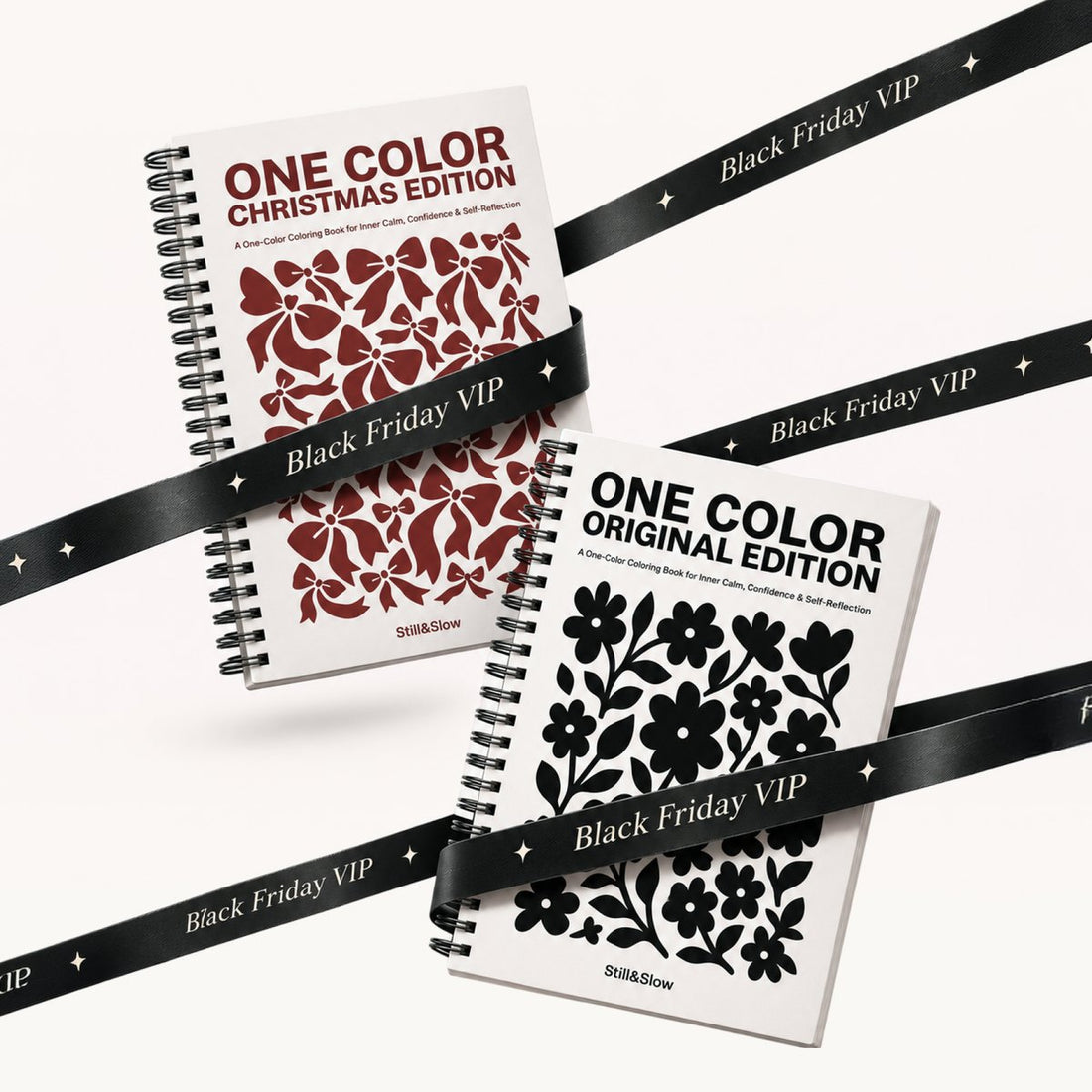
For December, there are two ways in. The one-color coloring advent calendar holds 24 drawings behind numbered tear-out pages, one for each evening from December 1 to 24, so the only question each night is which number comes next. The Christmas Edition coloring book collects winter and Christmas scenes with no countdown, which suits anyone who knows they will skip a few nights. The advent calendar is on preorder and standard delivery takes 5 to 12 business days, so order with some margin if you want it on the table by the first.
A simple plan for the rest of December
Take one small step each week rather than overhauling everything at once. Settle your decisions in the first week, protect your evenings in the second, trim expectations in the third, and spend the last stretch mostly doing less. The plan works because each step makes the next one easier, not because it is ambitious.
- In the first week, choose your gift rule and your three easy dinners.
- In the second week, block two evenings in the calendar and tell the people you live with.
- In the third week, ask everyone which traditions matter and drop one that nobody named.
- In Christmas week, keep one quiet hour a day with the phone out of reach.
Holiday stress: frequently asked questions
Most questions about holiday stress come back to the same few levers: fewer decisions, more protected time, and expectations set before the month starts rather than halfway through it. The short answers below cover the situations people ask about most, from hosting to tight budgets to feeling low once the season is over.
How can I reduce holiday stress before December starts?
Make your big decisions in November. Choose a rule for gifts, agree with your household on the two or three traditions that matter, block two quiet evenings a week in the calendar, and settle a total for spending. Once those are fixed, December becomes a matter of following a plan instead of improvising one every evening.
Why do the holidays feel so exhausting?
Because December adds work without removing any. You still have your usual job and home life, plus gifts, events, travel, cooking and more time with people, while the quiet evenings that normally help you recover are the first thing to go. The tiredness comes from the stacking, not from any one task.
How do I stay calm when I am hosting Christmas?
Simplify the menu to dishes you have cooked before, accept help when it is offered, and prepare as much as possible the day before. Plan a short break for yourself during the day, even ten minutes outside. Guests remember a relaxed host far more than a perfect table.
How do I handle holiday stress when money is tight?
Set one total before you shop and divide it, rather than deciding gift by gift. Suggest a name draw among the adults so each person buys one present, and lean on traditions that cost little, like a lights walk, a shared meal or homemade cookies. Saying it early to family takes most of the pressure away.
Is it normal to feel low after Christmas?
Many people feel flat once the season ends: the routine returns, the days are short, and the build-up is over. Plan one small thing to look forward to in January and keep your evenings gentle. If the low feeling lasts or gets in the way of daily life, talk to your doctor or someone you trust.
Looking for something calm to fill your protected evenings? Start with the coloring advent calendar, one page a night until Christmas.