The Benefits of Coloring for Adults: What Holds Up, and What Doesn't
Coloring isn't just for kids. Research links adult coloring to lower anxiety and improved focus. Here's what the science says, and why simpler is better.

Most articles on this subject promise a lot and source very little. This one does the opposite. There are two good controlled studies on adult coloring, they both point at the same thing, and that thing is not creativity. It is structure. Here is what the evidence supports, what it does not, and what actually has to be true for a coloring habit to do anything for you.
What are the benefits of coloring for adults?
Coloring lowers anxiety, holds attention without demanding effort, and gives the end of the day a clear stopping point. Two controlled studies support the anxiety part. The rest is what colorers consistently report: it is relaxing, easy to pick up after work, and more addictive than it sounds. Artistic skill has nothing to do with it.
That last point is the one people get wrong. The benefit does not come from expressing yourself. It comes from following lines that are already drawn, in a task with no wrong answer, for twenty minutes. The research backs this up in a way that is unusually specific, and it matters when you choose a book.
What the research on adult coloring actually found
Two studies are worth knowing. Curry and Kasser at Knox College in 2005 found that coloring a structured design lowered anxiety, while drawing freely on a blank page did not. Flett and colleagues at the University of Otago in 2017 found that one week of daily coloring lowered anxiety and depressive symptoms. Both land on structure.
Structured coloring lowered anxiety. Free drawing did not.
Curry and Kasser induced mild anxiety in participants, then split them into groups. One group colored a pre-drawn, structured design. Another drew freely on a blank sheet. Anxiety dropped measurably in the structured group and did not in the free-drawing group. Same materials, same amount of time, different result.
The blank page is the problem. A blank page asks you to decide what to make, and deciding is the thing you were trying to get away from. A printed outline removes that question entirely. You do not have to think, you just color.
One week was enough to show a change.
The Otago study asked adults to color every day for a week and compared them to a control group. At the end of seven days, the colorers reported lower anxiety and fewer depressive symptoms. Seven days is a short window for a habit to register at all, which is the useful part of that result: you do not need months before anything happens.
What these two studies do not say.
They do not say coloring treats anything. They do not compare one coloring book to another, they do not measure how many colors you use, and they do not establish an ideal session length. Anyone quoting a precise number of minutes, a percentage, or a brain chemical is going past what these studies measured. The honest summary is narrower and still useful: structured coloring, done daily, lowers self-reported anxiety.
Why coloring calms you down: it takes decisions away
A normal weekday ends with a mind still running open loops. Coloring closes most of them by accident. The shape is decided, the outline is decided, there is no outcome to optimize and nothing to get wrong. What is left is rhythm. Fill, breathe, repeat, until the page is finished.
This is also why the format of the book changes the result. A classic book plus a tin of forty-eight pencils hands the decisions straight back to you. Which color for the sky. Does this green clash with that blue. Should the flowers match. You sat down to stop choosing and you are choosing again, only now it is about turquoise.
Taking the palette down to a single pen is the logical end of that idea, and it is the whole premise behind what monochrome coloring is. The studies tested structure rather than palette size, so treat that as a reasonable extension rather than a proven finding. In practice it is the difference between a meditation app with four hundred options and one bell.
Is mindful coloring better than meditation?
It is not better, it is easier to keep up. Seated meditation asks you to sit still with your thoughts, which is hard precisely when you are anxious. Coloring gives your hands a job and your eyes a target, and attention follows on its own. For a lot of people that difference decides whether the habit survives past week two.
Neither one wins on paper. The one that works is the one you actually do on a Tuesday night when you are tired. If sitting still has never stuck for you, that is information about the method, not about you.
How long should you color before the benefits show up?
Start with ten to twenty minutes and repeat it daily rather than saving it for a long Sunday session. The Otago study ran for one week of daily coloring, so consistency is the variable with evidence behind it. Session length is not. Short and regular beats occasional and long, and it is far easier to sustain.
Pick a fixed slot so you are not negotiating with yourself every evening. After dinner and before bed is where most colorers land, because it doubles as a nightly wind-down and the page gives the day an obvious end. Instead of doomscrolling for half an hour, you color for half an hour, which is a swap rather than a sacrifice.
Who tends to get the most out of coloring
People who find sitting still difficult, people with long stretches of waiting to fill, and people whose days are spent looking after someone else. The common thread is wanting something absorbing that asks nothing back. Coloring suits all three because it can be picked up for ten minutes and put down mid-page without any cost.
Restless attention is the clearest case. A task with visible progress and no blank page to confront is well matched to a brain that stalls on open-ended work, which we look at in more detail in coloring for adults with ADHD. Waiting rooms, recovery after an operation, and long evenings spent caring for a parent come up constantly in what colorers tell us, for the same reason: the page is undemanding and it keeps.
What stops the benefits from showing up
Four things, mostly. Too much choice in the box. Ink that bleeds through and ruins the page you just finished. Treating the result as something to be judged. And keeping your phone within reach, which splits your attention and quietly undoes the point of the whole exercise.
The bleed-through one is worth taking seriously, because nothing kills a habit faster than finishing a page and finding it ghosting onto the next. Thick paper and single-sided printing solve it on the book side, and the pen matters just as much, which is why we keep a guide to the best markers for adult coloring books.
Aiming for pretty is the subtler trap. The page is a means, not an end, and nobody is grading it. If you find yourself redoing a section, you have turned a calm task back into a performance. As for color choice, people do have genuine preferences about which shades feel calm, and we went through which colors people find calming separately, but it is far less decisive than simply having fewer of them.
How to start tonight
Print one page, pick one pen, and give it twenty minutes with your phone in another room. Do not buy anything yet. If it holds your attention on a weeknight when you are tired, it will hold it in three months, and that is the only test that matters before you spend anything.
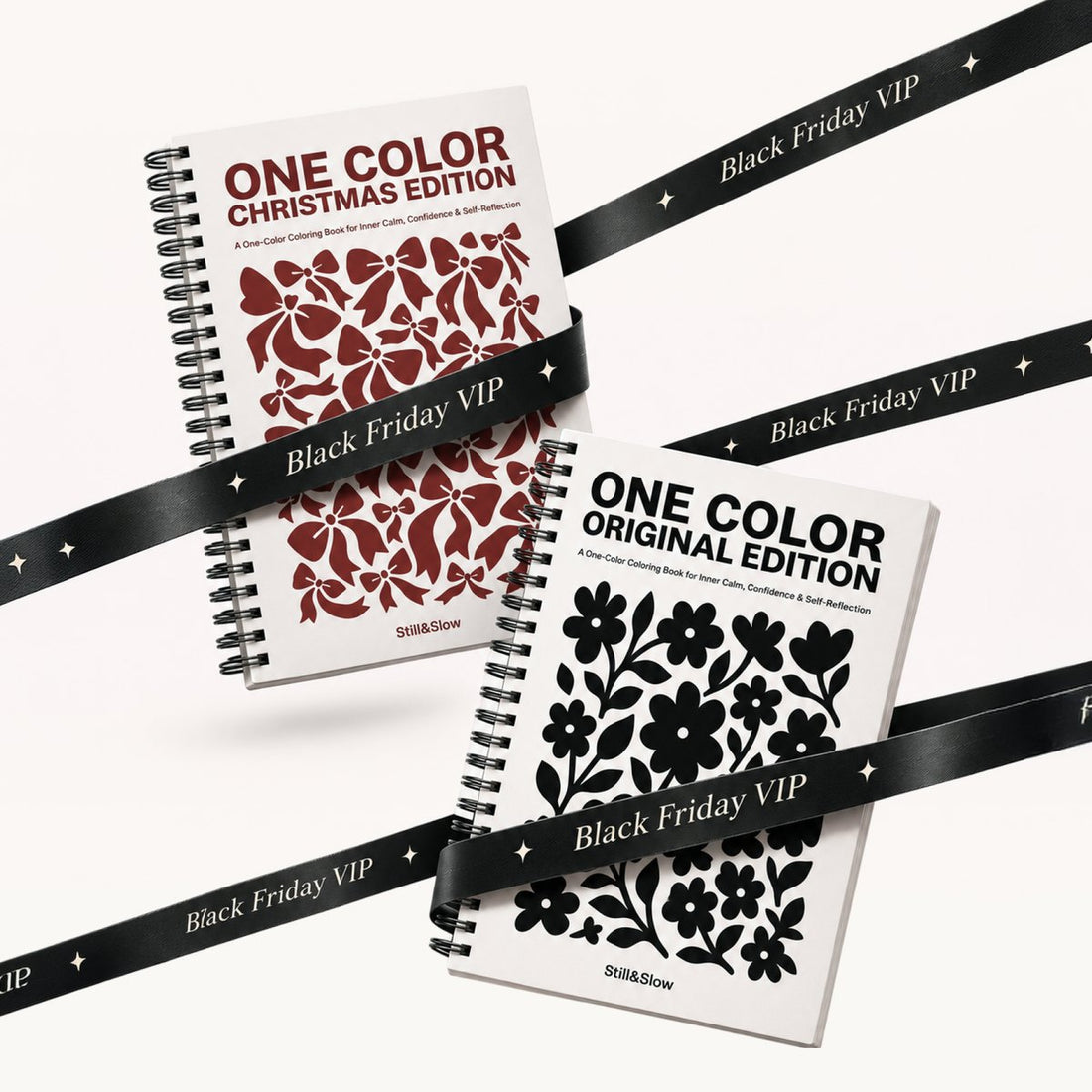
We put together five free coloring pages you can print tonight for exactly this. If it sticks, the One Color Coloring Book, Original Edition is where most people start, the Wellness Edition suits a slower evening slot, and the full collection of one-color coloring books covers the rest. Spread across a few months of evenings, the cost per evening is lower than almost anything else you would do with that half hour.
Frequently asked questions
The questions below come up most often, and the answers stay inside what the evidence supports. Where something is a preference rather than a finding, it says so. Nothing here is a substitute for talking to a professional about anxiety, and no coloring book should be sold to you as one.
Does coloring actually reduce anxiety?
In controlled conditions, yes. Curry and Kasser (2005) found that structured coloring lowered anxiety where free drawing did not, and Flett and colleagues (2017) found the same after a week of daily coloring. Both measured self-reported anxiety in small groups, so treat it as a useful calming habit rather than a treatment.
What are the drawbacks of adult coloring?
It is sedentary, it can turn into another thing you feel behind on if you set yourself a page-a-day target, and a book with too many choices can leave you more wound up than when you started. It also does nothing for the cause of the stress. It makes the evening calmer, not the week.
How long should I color to feel the benefits?
Ten to twenty minutes is plenty to start with. The study that showed a measurable change ran daily for one week, so regularity is what the evidence points to. Longer sessions are fine if you want them, but they are not what produced the result.
Do I need to be good at art?
No, and it works better if you are not trying to be. The study that worked used pre-drawn designs. The one that did not work used a blank page and free drawing. Skill is not the active ingredient here, structure is, and the lines are already on the page.
Does it matter how many colors I use?
No study has tested palette size directly, so this is reasoning rather than evidence. What is established is that removing decisions is what calms. Color choice is a decision, so taking it down to one pen follows the same logic. In practice colorers describe one-color pages as quicker to settle into and easier to finish.
Is coloring as good as meditation?
They are not interchangeable and no study compares them head to head. Meditation trains attention directly, coloring occupies it. For people who have tried sitting still and given up, coloring is usually the habit that lasts, and a habit you keep beats a better one you abandon.